Clicarity โ€บ Packaging
๐Ÿ“ฆ Industry ยท Packaging

In the last six months, which jobs went out quickest, and why?

And which stage held up the most jobs. Which client's approvals cost you the most days. How many more jobs the same press could have finished.

One press found that jobs were sitting four days at lamination, month after month, on almost every order. Nobody had ever measured it.

Three presses. Each one thought they already knew where the time was going.

None of them were careless. They were all running on the same thing every press runs on, what people remember, and what people say when you ask.

01 Artwork

A rigid box manufacturer in Mumbai was asked how long artwork corrections usually take. He said a few hours. Everyone in the room agreed.

Nobody had measured it, because there was nothing to measure it with. A file went to the designer, and it came back when it came back.

Where one job actually spent its time
Design work3 hrs
Waiting2.1 days
Work happening Job sitting, nobody informed

Once every stage carried a timestamp, the average came out at 2.4 days per job, and almost none of it was design time. The file was simply sitting. The designer did not know it had arrived, and the person who sent it assumed it was being worked on.

He changed one thing. Every artwork query had to be answered within four hours, and the screen showed anything older than that in red.

2.4 days โ†’ 0.9 dayswithin three weeks, same designer, same workload
Show me mine Fifteen minutes. We look at your artwork stage.
02 Lamination

A commercial printer knew he had wastage. Every press does. His quotes carried the usual allowance for it, and at month end the numbers looked close enough to what he expected.

What he could not see was which stage it was leaving from. Month-end tells you the total. It never tells you the address.

Sheets lost, stage by stage
Cutting2%
Printing3%
Lamination18%
Die cutting2%

Quantity in, quantity out, recorded at every stage. Within three days the answer was on the screen: lamination was losing 18% of every run.

The cause was not a mystery either. A worn roller. The operator had known for weeks, he had mentioned it once, to someone, and nothing happened. It was never anybody's specific job to escalate it, and there was no number that made it urgent.

Identified on day three. Roller changed on day four.

18% โ†’ 4%in one week, on the same machine
Find out where We will show you how it gets measured.
03 Dispatch

This one is the quietest, and it costs the most.

Jobs were finishing on time. The press was doing its work. But finished goods were standing in the packing area for an average of 1.8 days before dispatch was told they were ready, and billing only raised the invoice after dispatch confirmed.

From job complete to invoice raised
Job finishedDay 0
Sitting1.8 days
Invoice outDay 3

Nobody was at fault. The packer finished and moved to the next job. Dispatch had no reason to walk over. Billing was waiting to be told.

Three days, on every single order, for years. On a business raising invoices worth crores a year, that is a permanent three-day hole in the cash cycle, money already earned, sitting in a corner of the packing area.

Same-day dispatch and invoicingcash arriving three days earlier, every order
Show me mine Fifteen minutes. Bring one recent order.

None of these three needed a new machine, an extra shift, or one more person. Every one of them was solved by being able to see something that was already happening.

Every stage. Every material loss. Every opportunity.

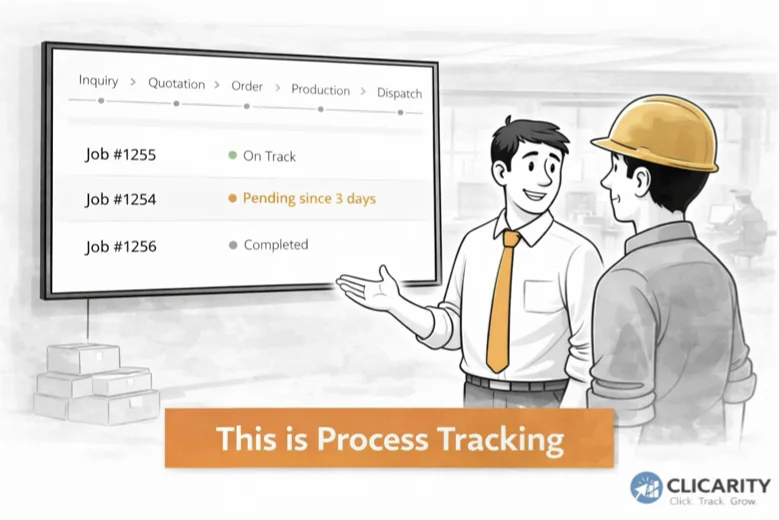
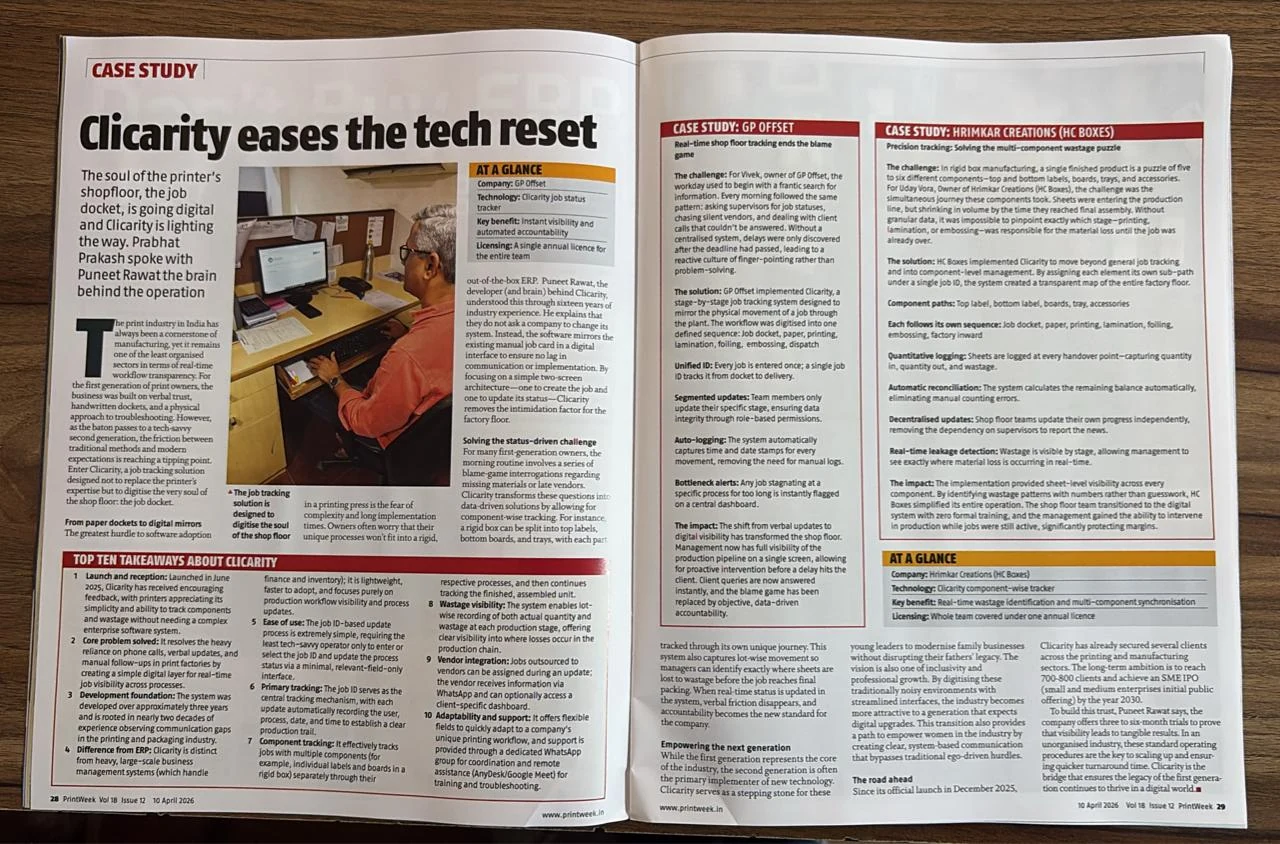
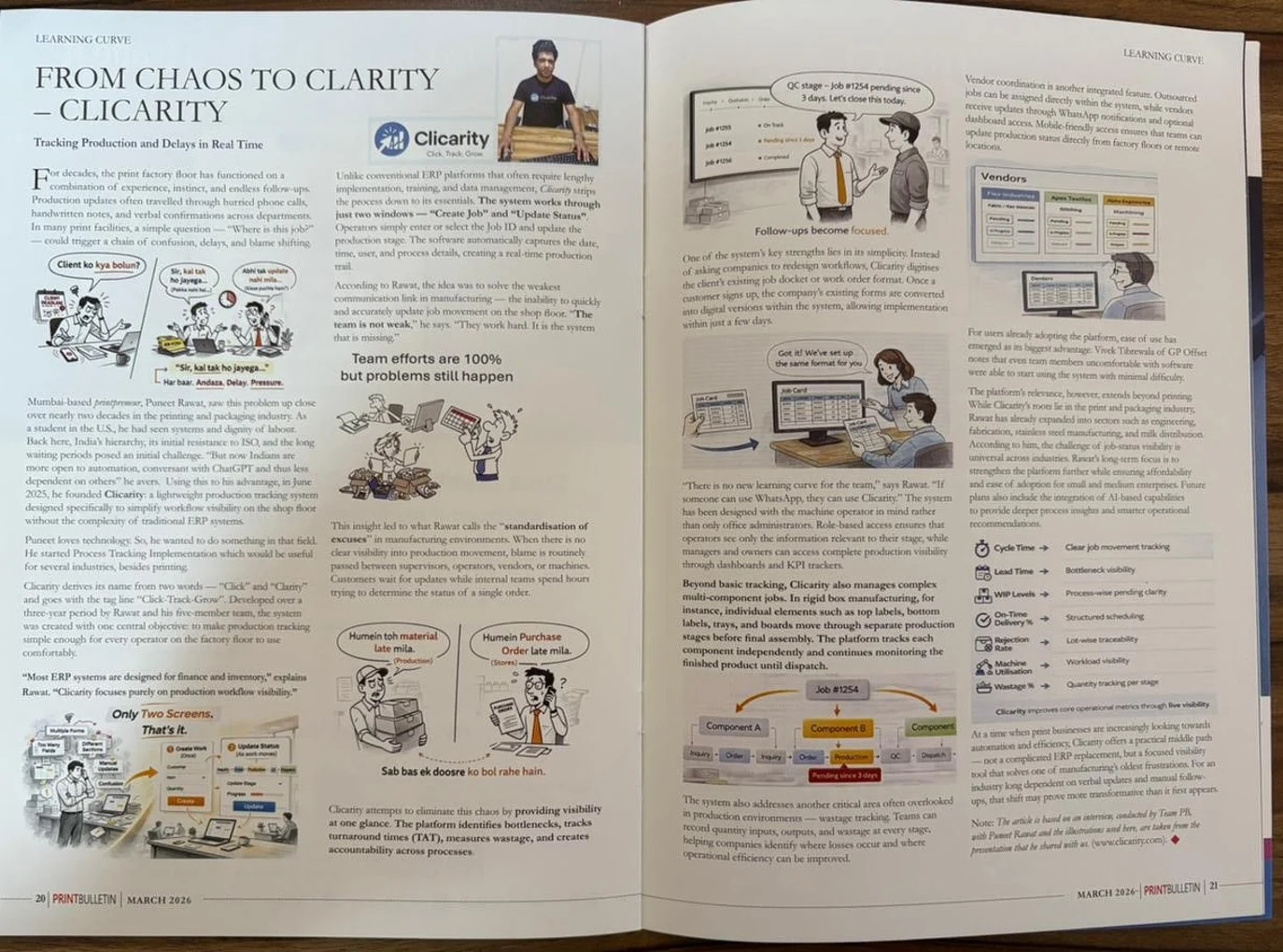
This is how a job moves through your press. Clicarity gives you live visibility at every phase, and flags delays before they become client calls.

01
Lead Generation & Order
1.2 days avg in this phase
4 stages
Enquiry Received
Client requirement noted, box dimensions, quantity, material, print finish.
โš  Common delay: specs incomplete, back-and-forth delays order start
Design / Artwork
Structural design and artwork created or received from client.
โš  Common delay: design revisions with no deadline, job waits
Order Confirmed
Client confirms specs, quantity, and delivery date.
โœ“ Clicarity: Job ID created, all specs logged, production starts
Material Planning
Paper, board, ink, and raw material requirements calculated.
โš  Common delay: material shortfall found only when production starts
02
Pre-Production
2.4 days avg in this phase
4 stages
Raw Material Procurement
Board, paper, inks, and substrates ordered or pulled from stock.
โš  Common delay: vendor late, production line waits
Die / Tool Preparation
Die made or pulled from store for the box shape.
โš  Common delay: die not ready, entire job delayed
Pre-Press
Artwork prepared for print, colour separation, proofing.
โœ“ Clicarity: Stage timestamped, next stage notified automatically
Machine Setup
Press, die cutter, and folder-gluer set up for the job.
03
Production
4.6 days avg in this phase
7 stages
Sheet Cutting
Board or paper cut to required sheet dimensions.
โœ“ Clicarity: Quantity in/out logged, first wastage checkpoint
Printing
Sheets printed with artwork, offset, flexo, or digital.
โš  Common delay: colour matching issues, reprint required
Lamination / Coating
Gloss, matte, or specialty coating applied.
โš  Common delay: highest wastage stage, material loss often invisible
Die Cutting
Sheets cut into box blanks using the die.
โœ“ Clicarity: Rejection rate tracked per run, pattern visible
Stripping / Window Patching
Waste board stripped; window film applied where needed.
Folding & Gluing
Box blanks folded and glued into final box shape.
โš  Common delay: glue machine issues cause batch rejection
Counting & Bundling
Boxes counted, bundled, and prepared for QC.
โœ“ Clicarity: Running count vs. order quantity tracked automatically
04
Quality Control
1.0 day avg in this phase
3 stages
QC Inspection
Boxes checked for print quality, dimensions, gluing, and finish.
โœ“ Clicarity: Pass/fail rate tracked, rejection reason logged
Rejection Handling
Rejected boxes set aside. Rework or reprint decision made.
โš  Common delay: rework re-enters production with no tracking
Client Sample Approval
Sample sent to client for approval before bulk dispatch.
โš  Common delay: client takes days to approve, entire lot waits
05
Dispatch & Delivery
1.8 days avg in this phase
3 stages
Packing & Palletising
Boxes packed into master cartons, palletised if required.
โœ“ Clicarity: Final quantity confirmed, shortfall flagged before dispatch
Dispatch
Consignment loaded and handed to logistics.
โœ“ Clicarity: Dispatch timestamp, vehicle details, and quantity logged
Delivered & Confirmed
Client acknowledges receipt. Job closed.
โœ“ Clicarity: Complete job history from order to delivery preserved
Map my stages Fifteen minutes. We put your stages on screen, live on the call.
"Now I can see at which stage the loss is happening while the job is still running. That alone has changed how I manage production. We used to find out about wastage only at month-end, too late to do anything about it."
UV
Uday Vora
Owner, HC Boxes. Rigid Box Manufacturing, Mumbai
Read the full HC Boxes case study โ†’
As featured in PrintWeek India, April 2026. Vol 18, Issue 12 โ†— Also in Print Bulletin, May 2026. Pages 20โ€“21 โ†—

What improves in packaging businesses using Clicarity

โ†“ 60%
Reduction in morning status calls
โ†‘ 89%
On-time delivery rate
โ†“ 70%
Wastage at lamination stage
5 days
To go live, full setup included

Questions from packaging manufacturers

How does Clicarity work for a packaging manufacturer specifically?
Clicarity is configured around your specific packaging workflow, design, cutting, printing, folding, gluing, QC, dispatch, in your terminology. Every job gets a unique ID and moves through your defined stages. You see live status, timestamps, and alerts the moment a job sits too long at a stage. The Clicarity team builds everything for you. You go live in 5 days.
Does it track material wastage at every stage?
Yes, with the Multi Licence. At every stage, your team logs quantity in and quantity out. Clicarity calculates the loss automatically and shows it live on your dashboard. You see exactly which stage is losing material while the job is still running, not at month-end.
Can it handle multiple packaging formats in one system?
Yes. Clicarity can run multiple process types simultaneously, corrugated boxes, flexible packaging, labels, cartons, each tracked independently with their own stage sequences. All visible on one dashboard.
Will my machine operators actually use it?
Yes. The update screen has two fields. Job ID and status. Under a minute. No training needed. Workers who have never used a smartphone can operate it from day one.

See your press. Every job. Every stage. Right now.

Book a free demo. We'll map your packaging workflow live on the call.

No commitment Live in 5 days Annual licence Full setup included